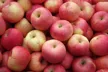

The apple has always been the most popular fruit in Switzerland. Per capita consumption for dessert apples was 14.66 kg between 2000 and 2002 and 13.9 kg in 2020. It was thus ahead of bananas and far ahead of other domestic fruits. What has changed, however, is the importance of individual apple varieties. Whereas in 2002 Golden Delicious had by far the largest acreage, the Gala is the most widely grown apple variety in 2020.
In general, the acreage used for apples has decreased over the last two decades. In 2002, apples were grown on 4471 hectares, but according to preliminary figures for 2020, this figure was around one fifth lower (3,671 hectares). However, there are also varieties that have increased in importance.
Area development of the top ten apple varieties
The diagram shows the area development of the top ten apple varieties grown in Switzerland, based on the average cultivation area of the last five years. According to this, Gala apples were cultivated on an area of 549 ha in 2002, which increased significantly in the following years and most recently accounted for 876 ha (+60%). In contrast, the cultivation of Golden Delicious has declined sharply from 1144 ha (2002) to now 361 ha (-68 %). It is followed by the Braeburn apple, which with 323 ha has replaced Jonagold from the third place of the most cultivated apples.
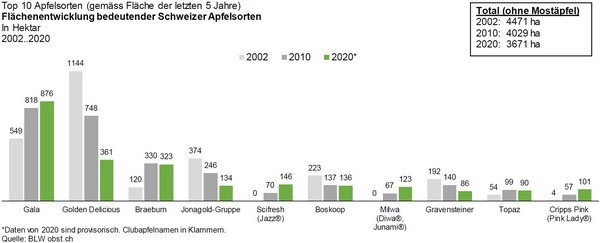
Braeburn and Topaz were able to escape the long-term downward trend experienced by many other varieties such as Jonagold, Boskoop, Gravensteiner, Maigold, Idared and Glockenapfel. Contrary to the downward trend, the Scifresh, Milwa and Cripps Pink varieties, which had almost no impact in 2002, developed well. Also noteworthy was the expansion of cultivation of the Rewena variety, which recorded an increase from 5.5 ha (2019) to 94.9 ha (2020). An overview of the areas by variety can be found on the FOAG website: Area Statistics for Fruit.
Reasons for changing varieties
Cultivation decisions depend on a variety of factors, such as the availability of new cultivars or changing demand over time. Marketing as a club apple also offers opportunities to increase revenue. Here, a limited group of participants (club) has the opportunity to market a variety under its brand name. For example, the three apple varieties Scifresh, Milwa and Cripps Pink can be marketed under their respective brand names Jazz®, Diwa® and Pink Lady® if certain quality requirements are met. This allows them to be sold at a premium price.
Club apples and Topaz with high prices
The second chart in the Swiss market report shows the average retail price achieved by the varieties in the periods 2007-2009 and 2017-2020 (up to and including October 2020). It can be seen that the established varieties Gala, Braeburn, Boskoop and Gravensteiner were in a medium price segment around a price of 3.50 CHF/kg in both periods. Golden Delicious had a slightly lower price around 3.20 CHF/kg, as did Jonagold 10 years ago (3.23 CHF/kg). Both varieties have had sharp declines in acreage over the past 10 years. In the meantime, the price of Jonagold has dropped to 2.20 CHF/kg.
Apples with a higher average price include Topaz, which is popular in the organic segment, and the varieties Scifresh/Jazz®, Milwa/Diwa® and Cripps Pink/Pink Lady®. In the case of Scifresh/Jazz® and Cripps Pink/Pink Lady®, very few apples were explicitly sold without a club name, i.e. as Scifresh (0.3%) and Cripps Pink (3.4%). Of the Milwa apple variety, significant sales were observed exclusively under the Diwa® brand.
The marked increase in the Topaz price can be explained by the fact that the organic share of Topaz has increased significantly over the last decade. For example, depending on the year, November stocks of Topaz were 36-44% organic during 2007-2010, while they were 65-90% organic during 2017-2020. Consequently, the majority of Topaz apples sold at retail in recent years were organic quality. Accordingly, Topaz offered potential for increasing revenues even without expanding production areas - but with higher production costs for organic commodities.
Click here to view the complete report (in German).
For more information:
Bundesamt für Landwirtschaft BLW
Schwarzenburgstrasse 165
3003 Bern, Schweiz
Tel +41 58 462 25 11
[email protected]