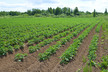

In the classic children’s game, nobody wants to be the one left holding the "hot potato". This also rings true for farmers, as rising global temperatures are bringing new meaning to the term. Producers know that being able to grow potatoes that can withstand heat-stress is becoming increasingly urgent.
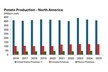
Helping producers find potato varieties that are more resistant to the potential disruption to growth caused by extreme heat is critical for ensuring the sustainability and profitability of potato production in Canada, which averages 4.5 million tonnes per year.
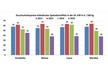
Recognizing this need, Dr. Xiu-Qing Li, an Agriculture and Agri-Food Canada (AAFC) research scientist with the Fredericton Research and Development Centre, has been studying heat-stress in potatoes for years, leading to a number of breakthroughs in recent years. In 2018, he teamed up with the University of New Brunswick and international collaborators to examine the response to heat-stress in 55 different varieties of potato, the first large-scale study of its kind. In most of the varieties studied, heat stress decreased leaf size, but increased leaf greenness and plant height, while severely reducing potato formation and mass. This study also identified which varieties were most heat-tolerant: Eramosa, Chieftain, AC Belmont, and Superior.
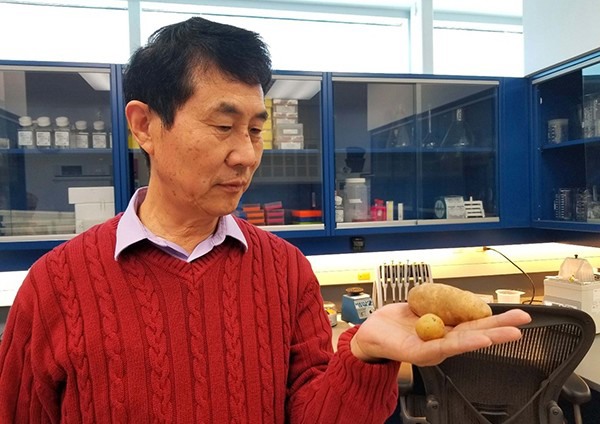
Identifying these varieties was an important first step, but even these potatoes did not fare particularly well in the heat, so it was clear that more research was needed. In 2020, Dr. Li collaborated with AAFC colleague Dr. Benoit Bizimungu, along with researchers from Queen’s University, on a study that went on to be recognized with an Outstanding Paper Award from the American Journal of Potato Research.
Their publication, "Effects of earliness on heat stress tolerance in fifty potato cultivars," determined that potato varieties known for reaching maturity early in the field grew at similar rates to later-maturing varieties when these were placed under heat stress in greenhouses, but the heat actually slowed down their maturation process. The research conducted by Dr. Li and his colleagues sought to pinpoint the specific potato genes that might help explain why that is, and the mechanisms that determine whether a potato variety will be early or late to mature.
On the heels of this award-winning study, Dr. Li launched and led a new research project to learn still more, taking a deeper dive into the genomic mechanisms of potato responses to heat-stress.
Click here to read the full press release.
For more information:
Agriculture and Agri-Food Canada
Tel.: 1-866-345-7972
[email protected]